Kunwer Sachdev’s TOI Blogs essay on the one HR habit that quietly costs Indian companies the most — vague job descriptions, and no measurable result-oriented matrix for what the role actually delivers.
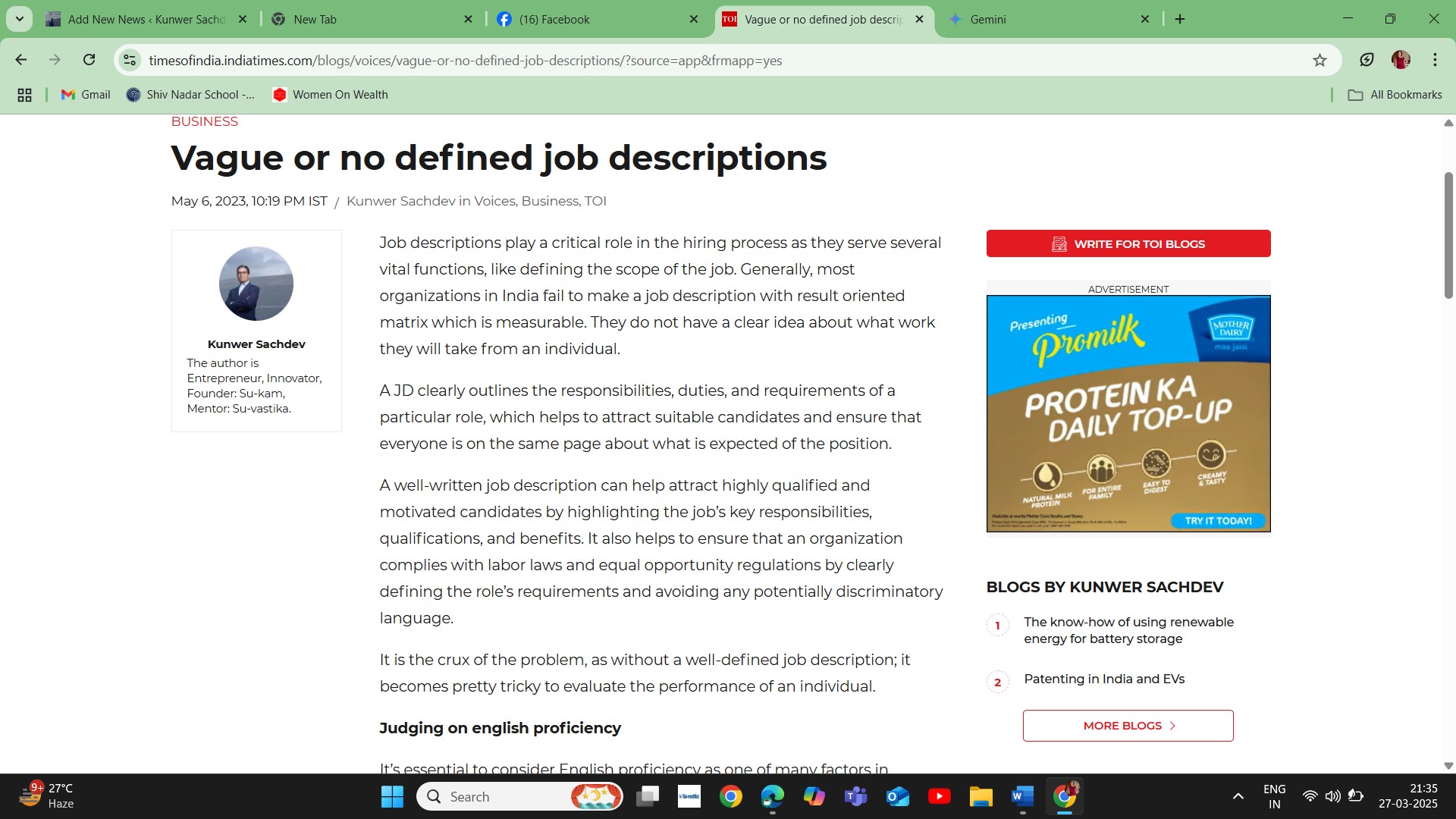
Kunwer Sachdev’s TOI Blogs essay is short and blunt: job descriptions are meant to define the scope of a role — and most Indian organisations write them badly, without a measurable result-oriented matrix, and often without a clear idea of what they actually want the person to do.
Why the JD matters more than most HR teams admit
A good JD does three things at once, Sachdev writes: it attracts the right candidates by describing the role honestly, it aligns everyone in the organisation on what “done” looks like, and it lets a manager measure the person against something concrete after they join. Skip any of the three and you get hires that never quite fit the shape of the work.
The Indian problem: no measurable matrix
His specific critique is the missing metric. Most Indian JDs list responsibilities in abstract nouns — “drive growth”, “manage team”, “handle vendors” — but no numbers, deadlines or output units. That is not a role definition; it is a wish list. Without measurability, appraisal becomes political, promotion becomes seniority-based, and both sides lose the plot.
“Most organisations in India fail to make a job description with a result-oriented matrix that is measurable — they do not have a clear idea about what work they will actually take from an individual.”— Kunwer Sachdev, Times of India Blogs • 6 May 2023
The fix Sachdev prescribes
The essay reads like a founder’s HR checklist: put the responsibilities in outcome-language, attach a measurable matrix to every responsibility, write qualifications and reporting lines that make the role hireable, and revisit the JD every quarter as the business shifts. A well-written JD, in his framing, is the single cheapest tool a company has to save itself from bad hires.
Vague or no defined job descriptions — Times of India Blogs →