March 2018: pv magazine India interviews Kunwer Sachdev on Su-Kam’s solar hybrid inverters, why Indian power backup has never been dominated by foreign vendors, and why he believes DC electricity is superior to AC.
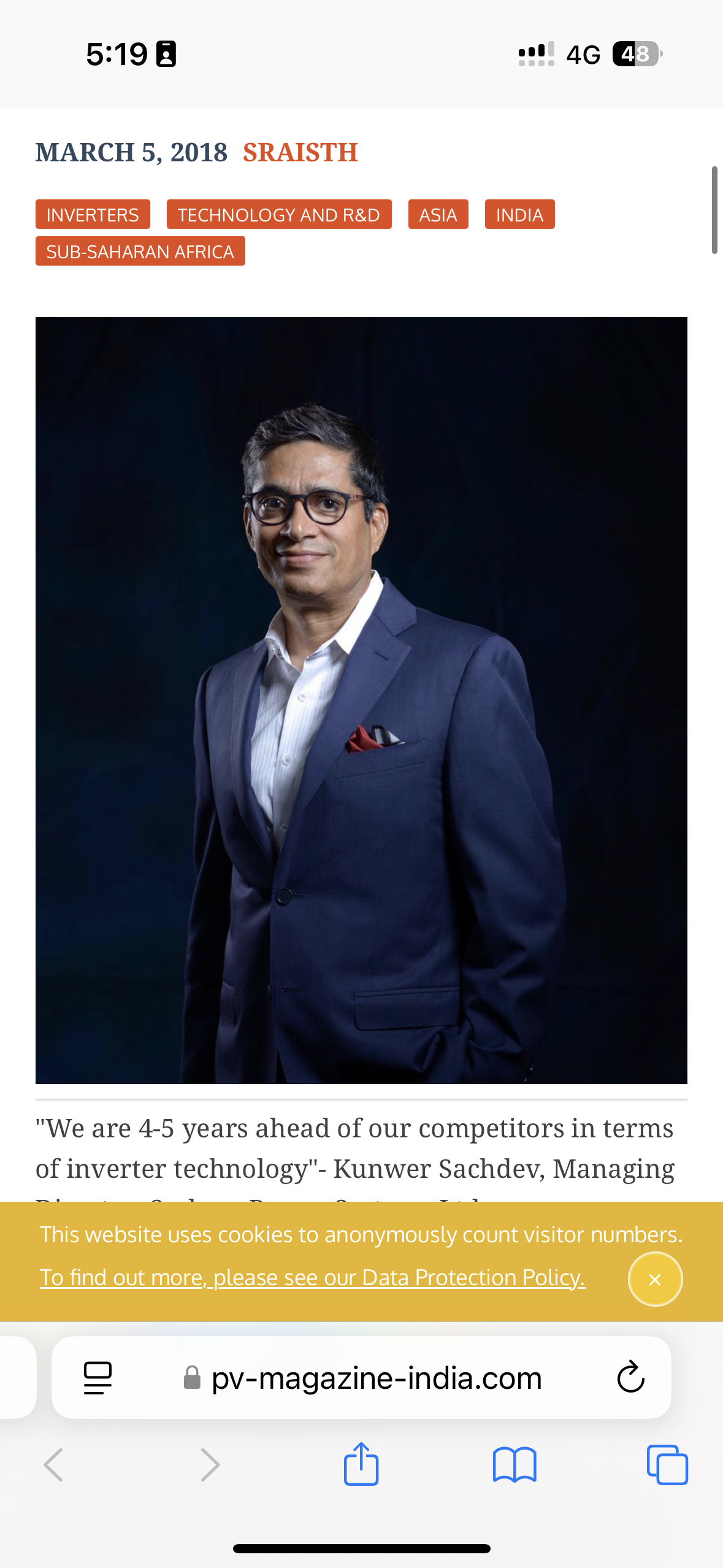
pv magazine India’s 5 March 2018 interview catches Kunwer Sachdev, Managing Director of Su-Kam Power Systems Ltd., on the technical questions the industry actually cares about: where Su-Kam sits against Chinese, European and Japanese competition, what its Solarcon and Brainy product lines do, and why he keeps arguing that DC is a fundamentally better fit for Indian rooftop solar than AC.
Why foreign brands never really took Indian power backup
Sachdev pushes back on the framing that Chinese, European or Japanese vendors dominate India. Indian power conditions — voltage swings, long outages, ambient temperature extremes — are so different from developed-market conditions that foreign inverters simply do not survive here without deep local engineering. That is the moat Indian firms built in this segment.
Solarcon, Brainy, and the ‘4-5 years ahead’ claim
Su-Kam’s Solarcon product turns a standard household inverter into a solar-compatible unit, and Brainy is its solar hybrid inverter line. Sachdev tells pv magazine his company is “4-5 years ahead of our competitors in terms of inverter technology” — a claim rooted in Su-Kam’s 100+ patents and its willingness to ship features (IoT, app control, retrofit-first design) that competitors are still on the whiteboard for.
“We are 4-5 years ahead of our competitors in terms of inverter technology.”— Kunwer Sachdev, MD, Su-Kam Power Systems • pv magazine India, 5 March 2018
Why DC beats AC for solar — the counter-intuitive bet
The most technical section of the interview: Sachdev argues that DC electricity is superior to AC for solar-plus-battery systems. Panels produce DC, batteries store DC, and most modern appliances run on DC internally after their own conversion. Every AC-DC conversion costs efficiency. Su-Kam’s hybrid design keeps as much of the chain in DC as possible — a choice the rest of the industry is only now catching up on.
Interview: Su-Kam is building solar hybrid inverters — pv magazine India →