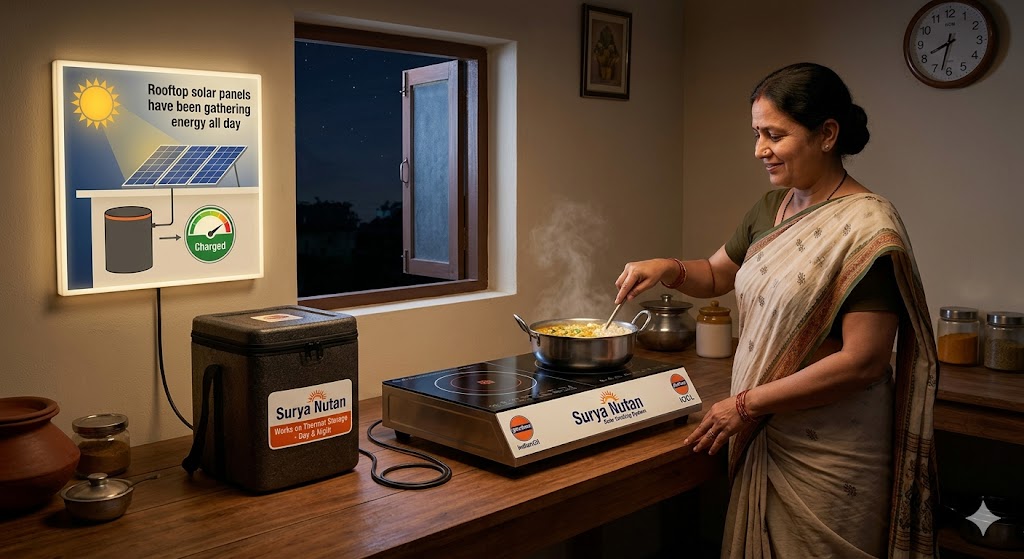
The year 2026 has brought a stark realisation to every Indian household: our food security is tied to the stability of distant waters. As the conflict in West Asia pushes LPG prices to record highs and delivery cycles stretch from days to weeks, a silent revolution is brewing on Indian rooftops. Solar induction is no longer a “future concept”—it has become a tool for national survival.
1. The Strategic Shift: From Oil to “Atmanirbhar” Sun
For decades, India has spent over $26 billion annually on LPG imports. In the current wartime scenario, this dependency has turned into a “choke point.” Unlike gas, which must travel through vulnerable maritime routes, solar energy is harvested where it is consumed.
By switching to solar induction, India isn’t just saving money; it’s achieving Energy Sovereignty. Every meal cooked with the “Indian Sun” is a meal that doesn’t rely on a ship passing through the Strait of Hormuz.
2. Solving the “Night Challenge”: Thermal vs. Chemical Batteries
The biggest question has always been: “How do I cook dinner when the sun is down?” In 2026, the answer has moved beyond expensive lithium batteries.
- Thermal Storage (The Surya Nutan Model): Developed by Indian Oil (IOCL), these systems use a “thermal battery” filled with phase-change materials. It “charges” by capturing heat during the day and stores it so efficiently that you can fry, boil, or bake rotis at 9:00 PM using nothing but the afternoon’s sunlight.
- Solar Hybrid Systems: Most modern solar induction units are now “Hybrid.” They prioritise solar power during the day and, if the storage runs low, automatically draw a small “trickle” from the grid or a secondary battery at night, ensuring the kitchen never goes cold.
3. From Homes to Mega-Events: Scaling the Solution
The transition is happening at two distinct levels:
In the Home: The “Solar Cylinder”
Innovative startups are now piloting “Solar Cylinders”—modular, swappable battery packs charged at community solar hubs. Much like the old LPG delivery system, you can exchange a depleted battery for a sun-charged one, making solar cooking accessible even for those without rooftop space.
At Events: Steam Power
For large-scale community events and weddings, India has successfully deployed Concentrated Solar Thermal (CST) systems. Using giant Scheffler reflectors, these systems generate high-pressure steam that is stored in “Accumulator Tanks.” This allows for the preparation of thousands of meals—even for late-night wedding feasts—without burning a single litre of commercial LPG.
4. Is This Still “On Paper”?
Sceptics often ask if these schemes are real. As of 2026, the evidence is in the field:
- IOCL’s Surya Nutan has moved from its 60-location pilot to a full commercial launch with authorised manufacturers like Pegasus Power and Redren Energy.
- The PM-Surya Ghar Yojana has already subsidised rooftop installations for millions, providing the electrical backbone needed for induction cooking.
- Real Savings: Recent data shows that electric induction is now 37% cheaper than unsubsidized LPG, making it a financial win as well as a strategic one.
The Verdict
The 2026 energy crisis has proven that we cannot afford to wait. The technology is here, the manufacturers are ready, and the sun is free. Switching to solar induction is no longer just a “green choice”—it is our best defence against global volatility.