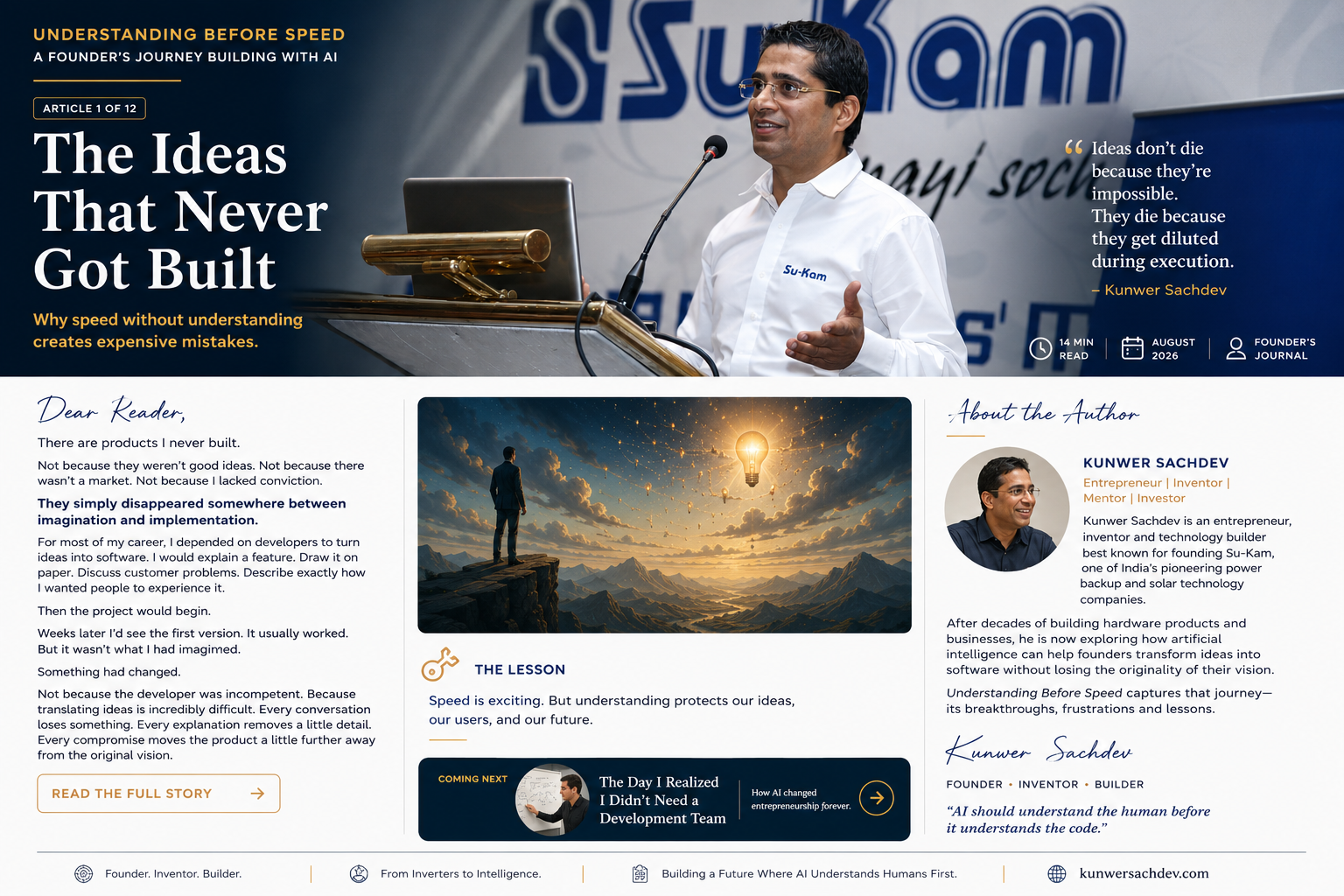
UNDERSTANDING BEFORE SPEED
A FOUNDER’S JOURNEY BUILDING WITH AI
ARTICLE 3 OF 12
Why AI Still Needs Human Judgment
The evening I handed everything to AI — and what it cost me.
12 Min Read | July 2026 | Founder’s Journal
AI has information. Humans have scars. And scars are surprisingly valuable.
Kunwer Sachdev
Dear Reader,
There is a strange confidence that comes with using AI for the first time.
The first few weeks are almost magical.
You type a question. Within seconds, an answer appears.
You ask it to write code. It writes code.
You ask it to solve a problem that would have taken your team an entire afternoon.
It solves it before your coffee gets cold.
For a while, you begin to believe something quietly dangerous.
“Maybe I don’t need to think as hard anymore.”
I nearly fell into that trap. Here is what saved me.
The Evening Everything Looked Perfect
I was deep into building DoctorRating — a platform where patients can review doctors honestly, and doctors can build reputations they actually deserve.
Every page represented weeks of thinking. Dozens of corrections. Hundreds of tiny decisions about what belonged and what did not.
It was far from perfect. But it was finally beginning to feel like mine.
Then I looked at my task list.
SEO needed improvement. Schema markup was incomplete. Several pages lacked internal links. The design could be cleaner. Meta descriptions needed rewriting. Performance could be better.
Normally, I would solve these problems one at a time. Carefully. Deliberately.
That evening, I thought: Why not let AI fix everything at once?
After all, it never gets tired. It doesn’t ask for overtime. It simply works.
So I gave it every instruction I could think of.
Improve everything. Optimize everything. Fix everything.
The Silence Before the Storm
For the next few minutes, I watched lines of code appear faster than I could read them.
Folders changed. Files were updated. New components appeared. Functions were rewritten.
I remember smiling.
This was exactly the future everyone had been talking about.
Then I opened the website.
At first, nothing looked obviously broken. In fact, it looked cleaner. Faster. More polished.
But something didn’t feel right.
So I clicked another page. Then another. Then another.
That was the moment my smile disappeared.
Death by a Thousand Tiny Changes
The homepage still worked. But one internal link had quietly vanished.
The pricing page loaded correctly. But its structured data was gone.
The article pages looked beautiful. Except the navigation no longer behaved the same way.
One improvement had broken something else. Then another. And another.
None of the mistakes were dramatic enough to trigger an alarm. Instead, they revealed themselves slowly over the next six hours.
I wasn’t building anymore.
I was investigating.
AI had done exactly what I asked. The problem was not AI. The problem was me.
AI Doesn’t Know What Success Looks Like
This was a difficult truth to accept.
AI understands instructions very well.
It does not understand success at all.
Those are two completely different things.
If you tell AI, “Improve my website,” it has no emotional attachment to the pages you spent weeks perfecting. It doesn’t know which sentence took you three hours to write. It doesn’t know which customer journey matters most to your business.
It only sees patterns. Possibilities. Probabilities.
The judgment still belongs to you.
Experience Is Still Irreplaceable
This is something I learned long before AI existed.
When I was building hardware products at Su-Kam — inverters, solar systems, UPS equipment — people often asked why I still reviewed prototypes myself. After all, I had engineers. Quality teams. Managers.
They could handle it.
But experience notices things that checklists never will.
A slight vibration. A sound that feels wrong. A connector that looks strong but won’t survive three years of use in a customer’s home.
Judgment isn’t built from information.
It is built from living through hundreds of failures.
AI has information.
Humans have scars. And scars are surprisingly valuable.
I Changed One Habit
Since that evening, every conversation with AI begins differently.
I no longer write: “Do this.”
I write: “Before you write a single line of code, tell me what you think I am trying to achieve.”
That one sentence has saved me hundreds of hours.
Sometimes AI misunderstands me.
Sometimes I realise I misunderstood myself.
Both discoveries are equally valuable. Because once understanding is clear, execution becomes easy.
The Real Lesson
People often ask me: “Are you afraid AI will replace entrepreneurs?”
My answer is always the same.
No.
I am far more concerned about entrepreneurs replacing their own judgment with AI’s confidence.
AI speaks with remarkable certainty. Life does not. Business does not. Customers certainly do not.
Real entrepreneurship has always been about making good decisions with incomplete information.
That hasn’t changed.
What has changed is the speed at which we can now test those decisions.
And that is a wonderful thing — as long as we never confuse speed with wisdom.
The future will not belong to the entrepreneur who uses the most AI. It will belong to the one who understands the problem better than anyone else.
THE LESSON
AI speaks with certainty. Life does not. The judgment to know the difference still belongs entirely to you.
FOUNDER’S NOTE
I don’t remember the prompts that worked. I remember the moments that forced me to think differently. Perhaps that is AI’s greatest gift — not better answers, but better questions.
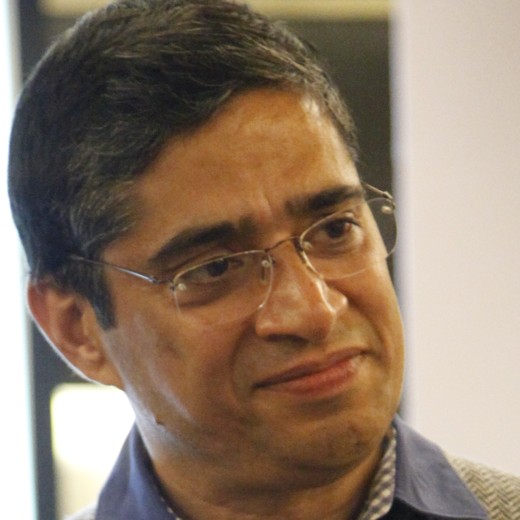
About the Author
Kunwer Sachdev
Entrepreneur | Inventor | Mentor | Investor
Kunwer Sachdev is an entrepreneur, inventor and technology builder best known for founding Su-Kam, one of India’s pioneering power backup and solar technology companies. After decades of building hardware products, he is now exploring how AI can help founders build software without losing the originality of their vision.
AI should understand the human before it understands the code.
Disclaimer: It is important to note that while Mr. Kunwer Sachdev founded Su-Kam Power Systems, he is no longer associated with the company as of 2019. Any information regarding his involvement in the company’s operations, strategies, or future plans reflects his tenure prior to that date. Therefore, any discussions or analyses of Su-Kam Power Systems should be considered in the context of his past contributions and not his current association with the company.
Founder. Inventor. Builder. | From Inverters to Intelligence. | kunwersachdev.com