Dr Kushant Uppal & Intellizon: The Engineering Mind Behind Su-Kam’s Lithium Solar Street Lights

Disclaimer. I, Kunwer Sachdev, am no longer associated with Su-Kam Power Systems Ltd in any capacity. This article is a personal tribute and a first-person account of events from my time as founder of Su-Kam; it is written in my own voice and reflects my own recollection and views. It has not been reviewed or endorsed by Dr Kushant Uppal, by Intellizon (Intelizon), by Su-Kam, or by Reliance. All trademarks, brand names, product names, dashboards, photographs and screenshots referenced here belong to their respective owners. Nothing in this article should be read as a legal statement, financial advice, or a comment on any past or present insolvency, regulatory or court proceeding; it is offered solely to give credit and to honour an engineer whose contribution, in my view, deserves to be publicly acknowledged.

Some chapters of one’s professional life don’t sit comfortably until they are written down honestly. This is one of mine. I want to use this space to give credit where it is overdue, and to publicly honour an engineer whose work made one of Su-Kam’s most celebrated products possible — and who, through no fault of his own, bore part of the cost when things later went wrong at Su-Kam. His name is Dr Kushant Uppal. His company was Intellizon, based in Hyderabad.

An Engineer Who Came Home

Dr Uppal had spent meaningful years in the United States before he decided to return to India. He wasn’t returning to take it easy. He came back with a clear intent: to build a real engineering company in the field of solar and LED-based outdoor lighting, in India, for Indian conditions. He set up his company — registered formally as Intelizon Energy Private Limited (CIN U40106TG2007PTC052755), incorporated in Telangana in 2007, often written as Intellizon or Intelizon — in Hyderabad and quietly began working on technology that, at the time, almost no one in the Indian market was attempting at his depth — lithium-ion battery integration, proper battery management, GSM-based remote control, and intelligent LED driver design, all on a single solar street-light platform.

How We Met

I met Dr Uppal at an industry exhibition. He wasn’t on a big stage. He wasn’t surrounded by a marketing team. He was at a stall, in front of his own product, talking to anyone who was curious enough to stop. I stopped. Within a short conversation I realised three things: he understood his technology end-to-end, he was solving a real Indian problem, and he was a decent, modest human being. I have built my career on backing engineers like that. I made up my mind, in that conversation, that I wanted Su-Kam — or me — to back him.

The Investment — And a Decision That Was Not Mine Alone

I have to be honest about how this part went, because it later mattered. I wanted to invest in Intellizon personally. That was my preference and my instinct. But by then, Su-Kam had taken on Reliance as an institutional investor, and the Su-Kam board took the view that an opportunity of this kind should sit on Su-Kam’s balance sheet, not mine. The board pushed for the investment to come from the company. I accepted that decision in good faith. Su-Kam invested in Intellizon, and Intellizon’s products were thereafter taken to market through Su-Kam’s distribution and institutional channels.

Years later, when things at Su-Kam went into a tailspin, the structure of that decision came back to matter — because Intellizon, as a company with Su-Kam holding a majority stake, could not insulate itself from Su-Kam’s collapse. I’ll come to that.

Who Sat on the Intelizon Board From Our Side

For full transparency: once Su-Kam invested in Intelizon Energy, two people from our side joined the Intelizon board. My son, Kanav Sachdeva, was made a director on behalf of the family. Jyoti, who at the time was Su-Kam’s Executive Director, was also brought onto the Intelizon board. They represented our investment, our distribution support and our institutional relationships.

I should be equally transparent about my own knowledge after that. After 2018, I personally stopped taking operational updates on Intelizon. By then, the Su-Kam situation had taken on a life of its own, and my attention had shifted entirely to dealing with the issues at Su-Kam, the insolvency proceedings, and eventually my next chapter focused on AI as an investor and mentor through kunwwer.ai. Anything that happened at Intelizon post-2018 is not something I can speak to first-hand, and I will not pretend otherwise.

What Intellizon Actually Built

The popular memory in the industry is that Su-Kam launched “India’s first lithium-based solar street lights”. That is true — but only as a description of who put the product into the market under whose brand. The engineering that made the product real came from Dr Uppal’s team:

  • Lithium-ion + Battery Management System integrated directly into the fixture, replacing the old lead-acid box at the base of the pole.
  • Intelligent LED driver design that delivered 30–50% more usable brightness compared to typical outdoor lighting of the time.
  • Cloudy-day operation thanks to lithium chemistry and a proper SoC / depth-of-discharge profile managed by the BMS.
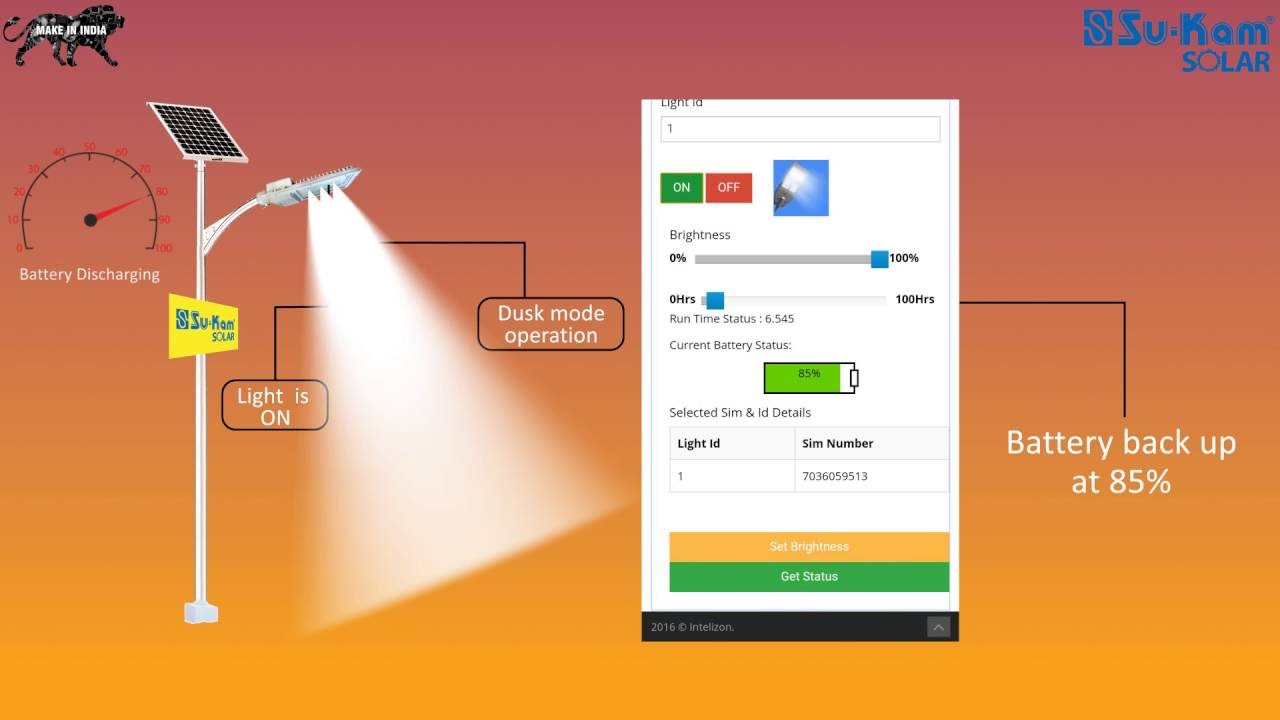
  • GSM-based remote control on the Sun Way GSM variant — each light addressable by ID, with on/off, brightness 0–100%, live battery status and cumulative run-time, all over a SIM card. Years before “smart city” became a buzzword in India.
Su-Kam Sun Way GSM dashboard — engineered by Intellizon, Hyderabad
The Sun Way GSM remote-control dashboard. Note the ‘© Intelizon’ mark at the bottom of the panel — a quiet fingerprint of who actually built this.

The Su-Kam Brand × Intellizon Engineering Combination

What Su-Kam brought was reach — a pan-India dealer network, an institutional sales motion (BSF, ITBP, public-sector road projects, large industrial buyers, schools, petrol pumps) and a brand that customers already trusted with their household power-backup. Combined with Intellizon’s technology, that pairing put India’s first lithium-based solar street lights on roads, borders and villages at a scale and a speed no individual company could have done alone. Both sides earned that credit. Intellizon engineered the product. Su-Kam carried it to market.

When Su-Kam Fell, Intellizon Was Pulled Down With It

This is the hardest part of this account to write, and the most important. When Su-Kam entered insolvency proceedings, the structure of the original investment meant that Intellizon — a company with Su-Kam as its majority stakeholder — could not stand clear of the cascade. The losses were enormous. Eventually, Intellizon too went into bankruptcy. An engineering company that had no part in the decisions that pulled Su-Kam down was nevertheless pulled down with it.

Dr Kushant Uppal, who had only ever conducted himself with integrity, took the hit — financially, professionally, and personally. He did not deserve any of it.

A Dignity I Will Not Forget

Here is the part that has stayed with me the longest. In all of it — through the insolvency cascade, through the financial losses, through the public and private pain — Dr Uppal never once complained to me. Not in conversation. Not in writing. Not through anyone else. He took the blow with a quiet dignity that most of us, including me, would struggle to match.

I have thought about this many times. It is easy in business to be loud when you are winning. It is much harder to be silent and decent when you are losing, especially when you are losing for reasons that are not yours to fix.

My Acknowledgement

To Dr Kushant Uppal — thank you. For your engineering, for your decency, and for your silence in a moment when you would have been more than within your rights to be loud. Su-Kam’s lithium solar street lights were yours before they were ours. The “Inverter Man of India” got that label partly because of products that men like you actually built. The least I can do, while I still have a voice, is to say that publicly.

To every engineer and team member at Intellizon — the Hyderabad office, the field deployment teams, the BMS and firmware engineers, the people who travelled to install on highways and at border posts — I see you, I am sorry, and I am thankful.

Why I Am Writing This Now

Because credit, like consequence, deserves to be named honestly. Because a young engineer reading this today — somewhere in Hyderabad or Pune or Bengaluru, debating whether to leave a comfortable US job and come back home to build hard things in India — deserves to know that the people who do that here are seen, and remembered, and named. And because my focus today has shifted to AI — building, mentoring and investing in early-stage AI ventures through kunwwer.ai — the lessons of how to honour the engineers who carry me are lessons I carry with me from this story. The next generation of Indian entrepreneurs deserves better than what Dr Uppal received from the system around him.

Related on KunwerSachdev.com

External resources

Scroll to Top