Most power backup devices are shipped after basic factory checks. At Su-vastika, we built our own automatic testing machine — because “good enough” was never good enough for us.
When an inverter or UPS fails during a power cut, the consequences go beyond inconvenience. Computers crash. Data is lost. Medical equipment trips. Industrial processes halt. That is why, at Su-vastika, we made precision testing the cornerstone of our R&D process — not an afterthought.
The Problem With Untested Power Backup Equipment
The inverter and UPS industry in India has long suffered from a lack of standardised testing. Many manufacturers rely on spot checks and visual inspection. Output waveform quality, load regulation, efficiency under varying conditions and battery charging accuracy are rarely measured with precision instruments. The result: products that pass the factory floor but fail in the field.
Su-vastika’s Automatic Testing Machine
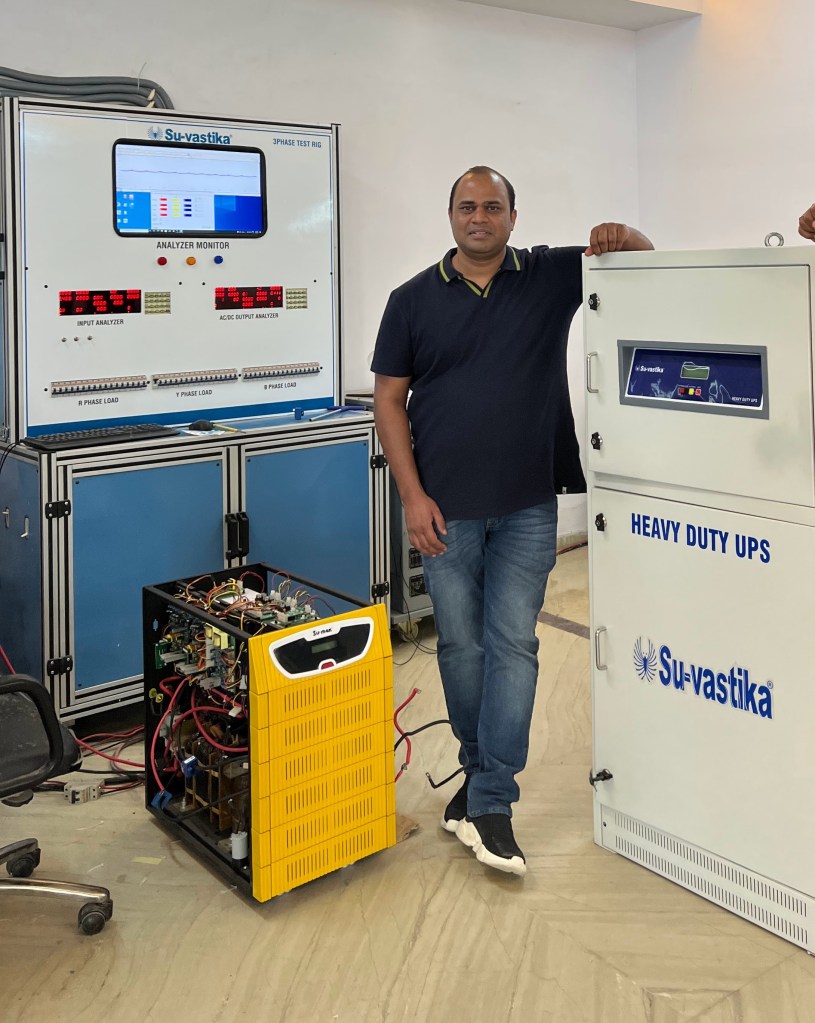
The R&D team at Su-vastika designed and built a custom automatic testing machine specifically for inverters, UPS units and solar inverters. This machine was not purchased off a shelf — it was engineered in-house to match our exact product parameters and quality benchmarks. Every unit that rolls off our production line is tested systematically, not randomly sampled.
The machine runs each device through a series of load conditions — from no load to full load and beyond — and records performance data automatically. This eliminates human error from the testing process and ensures every device meets the same standard, every time.
What Our Power Analyzer Measures
At the heart of our testing process is a high-accuracy Power Analyzer — the same instrument used in certified testing laboratories worldwide. It gives us real-time, traceable data on every critical parameter:
- Efficiency (%) — How much input power becomes usable output power across different load levels
- Total Harmonic Distortion (THD) — Waveform purity, critical for protecting sensitive electronics
- Power Factor — The ratio of real power drawn versus apparent power, vital for energy billing and grid compatibility
- Load Regulation — How stable the output voltage remains as load increases from 0% to 100%
- Charging Current & Voltage Profiles — Precision battery charging parameters to maximise battery life
- Switching Transients — The quality of changeover from mains to battery and back
Computer-Based Testing: Data You Can Trust
Su-vastika also uses a dedicated computer-based testing tool that logs every measurement, timestamps each test run and generates a traceable record for every product. This is more than quality control — it is a live R&D feedback loop. When our engineers spot a parameter drifting, they can isolate the cause, update the firmware or hardware design, and immediately retest. This cycle of measure, analyse, improve is what drives our continuous product upgradation.
Solar Inverter Testing — A Different Challenge
Testing solar inverters introduces variables that standard inverter testing does not cover. Solar input is variable — irradiance changes by the minute, and the inverter’s MPPT (Maximum Power Point Tracking) algorithm must respond intelligently. We simulate a range of PV input conditions in our lab to validate MPPT efficiency, grid-tie accuracy, anti-islanding response and Lithium battery compatibility. With solar and Lithium storage becoming central to our new product range, this testing capability is not optional — it is essential.
“You cannot improve what you do not measure. Our investment in R&D testing infrastructure is an investment in the reliability you experience every time the power goes out — and our product stays on.”
— Kunwer Sachdev, Founder, Su-vastika
What This Means for You
When you buy a Su-vastika inverter, UPS or solar inverter, you are not buying a device that passed a visual check. You are buying a device that has been run through an automated testing sequence, measured by a calibrated Power Analyzer and validated by a computer-generated test record. That data lives in our system — and it is the reason our warranty confidence is high and our field failure rates are low.
Precision testing is not a marketing promise. At Su-vastika, it is the standard process that every product goes through before it reaches your home or business.