The Su-Kam Legacy — A Brand That Stood the Test of Time
From ₹10,000 and a cable-TV office to India’s largest organised inverter company — exporting to 90+ countries, holding 77 patents, and redefining an entire product category. This is the Su-Kam legacy — my story, told properly.
From a Cable Shop in Delhi to One of India’s Most Respected Brands
At its peak, Su-Kam was the brand a Delhi household, a Lagos hospital and a Rwandan school all called when the lights were going out. I built it from a ten-thousand-rupee start and a corner of my cable-TV office into India’s largest organised inverter and power-backup company — a sine-wave, plastic-body, India-designed brand exporting to more than ninety countries.
I was born in Delhi in November 1962, the son of a railway employee in Punjabi Bagh. I studied statistics at Hindu College and went on to a Bachelor of Laws from the University of Delhi [1]. By the late 1980s I was running a cable-television installation and equipment business in Delhi alongside my elder brother — a profitable, hands-on operation that taught me retail, distribution and after-sales the hard way [2].
The pivot to power began with a frustration anyone in 1990s India will recognise: chronic outages. I started experimenting with backup units inside the cable business and saw a category that was technically primitive, brand-less and hugely under-served. On 14 October 1998 we formally incorporated Su-Kam Power Systems Ltd in Delhi — the corporate registry records the date and CIN to this day [3]. The starting capital was ₹10,000. The destination was a national brand [4].
Those years gave me three things I later spent at Su-Kam without having to learn them: a feel for which technical fixes Indian customers will actually pay for, a network of small dealers who understood retail margins, and a personal habit of running the business from the workshop rather than the boardroom. The pen-selling years before that — my elder brother and I went door-to-door on bicycles — explain the operating temperament: a founder who has done sales calls in person never quite believes the brand sells itself [4].
The Products That Built the Brand
The early Su-Kam product line moved fast. The first Indian inverters were standard transformer-and-board designs in heavy metal cases. Our first real breakthrough was electronics: India’s first MOSFET-based inverter, then India’s first microcontroller-based inverter, and then — the one that mattered — India’s first DSP sine-wave inverter, which removed the buzzing in fans and tube lights that square-wave units had inflicted on every backup-powered home [5].
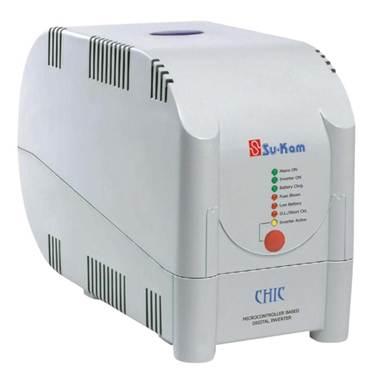
We launched Chic, the first plastic-body inverter in India and, by several accounts, the world. I convinced GE Plastics to develop a custom flame-retardant compound for the unit [6]. India Today went on to name the plastic-body inverter one of the country’s top-ten innovations of the decade [7]. Chic stayed in the market — and in customers’ homes — for the better part of twenty years.
By the late 2000s and into the 2010s the catalogue widened in three directions at once:
Residential
Tubular and SMF batteries, home UPS, Brainy and Brainy Eco solar hybrid home UPS lines [9]
Solar
PWM and MPPT charge controllers (12V–360V), Solarcon family of solar PCUs [8]
Industrial
Online and line-interactive UPS up to 500 kVA for offices, factories and data infrastructure
Smart Systems
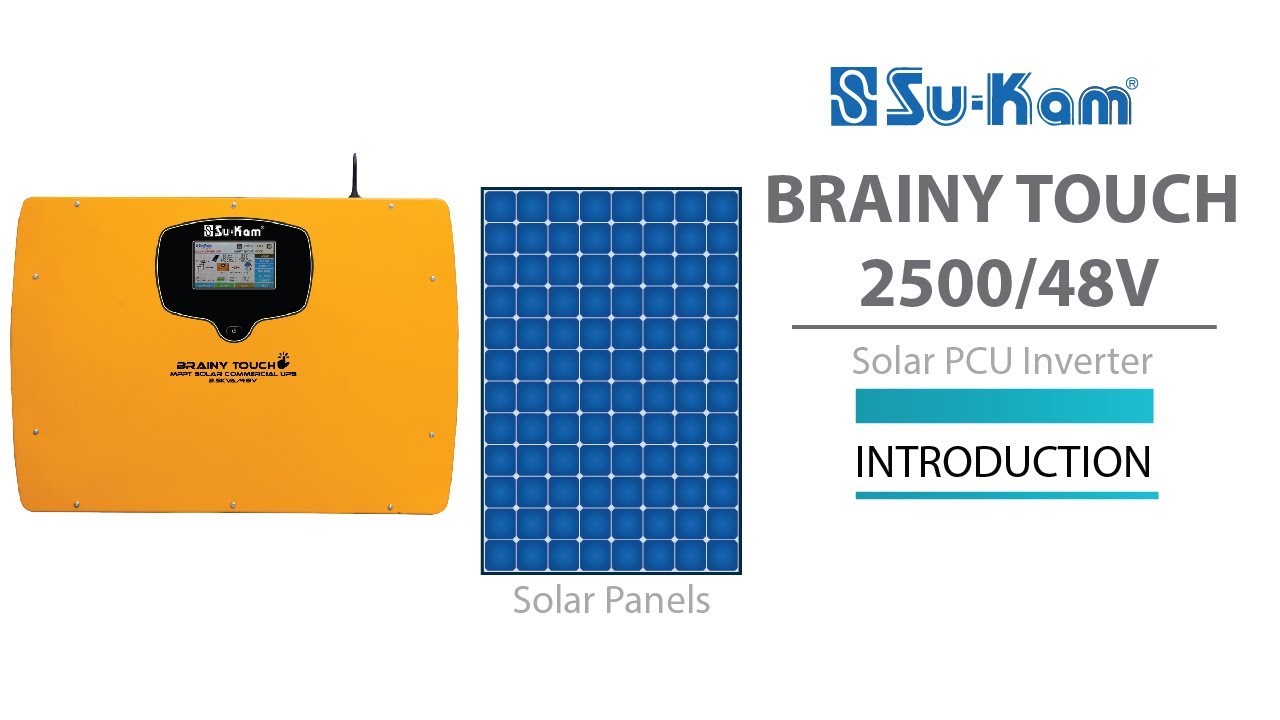
India’s first touchscreen solar PCU with built-in Wi-Fi monitoring and MPPT controller [10]
Su-Kam filed more than seventy technology patents and several hundred design patents, copyrights and trademarks across India, the United States and other markets — roughly two technology patents a month at peak [11]. The strategy was deliberate: lock in the technical territory the brand had opened, so that every plastic-body sine-wave inverter sold in India for the next decade would either be a Su-Kam unit or one designed around Su-Kam’s claims.
The Category I Created
Before Su-Kam, “inverter” in India meant a heavy, square-wave box bought from an unbranded local assembler, kept under the stairs and replaced when it failed. There was no category leader, no consumer brand, no national service network. We built one.
By the mid-2000s the company was the country’s largest organised inverter manufacturer, capturing a market share that contemporary trade coverage placed at over thirty-five per cent at peak [12]. Su-Kam was also the first Indian power-solutions company to win Superbrands India recognition — an industry milestone, because the category itself had not previously been seen as branded territory [13].
The home-UPS / inverter category as Indian buyers understand it today — sine-wave output, plastic body, named brand, dealer warranty, retail packaging, demoable in a showroom rather than discovered in a workshop — is, in large measure, the category my team designed.
The competitors who came after, including those who outlived Su-Kam itself, copied the template we wrote: brand the box, ship a sine wave, give the buyer something with a face on the carton and a service phone number on the back.
On 31 March 2006 the Reliance India Power Fund — a private-equity vehicle jointly sponsored by the Anil Dhirubhai Ambani Group and Singapore’s Temasek Holdings — acquired a twenty per cent stake in Su-Kam for ₹45 crore [39]. In 2006, this was an unusual signal: an Indian power-electronics company taking institutional money from one of the country’s largest groups and a sovereign-linked Singapore investor. It confirmed the inverter category had crossed from cottage trade into serious capital territory.
A Factory of Firsts
The operational base was Plot 54, Udyog Vihar Phase VI, Gurugram — Su-Kam’s headquarters and primary inverter plant [14] — supported at scale by a battery factory in Himachal Pradesh staffed by trained engineers and equipped for in-house testing [15].
Vertical integration was the deliberate strategy: design, electronics, plastics, batteries and software under one company umbrella, so that a sine-wave inverter, the battery it drove and the charge controller that fed it could all be engineered to work together rather than bolted into a system at the dealer’s shop floor. At its peak the company employed in the high hundreds and ran a pan-India service network [16].
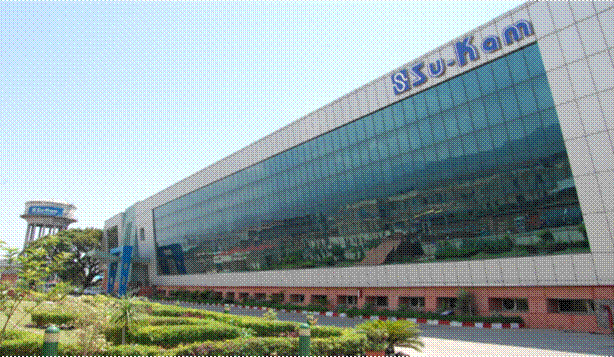
The plants ran ISO-certified processes for both quality and environment, and the in-house design team carried the work of three or four separate companies: power electronics, plastics tooling, battery engineering and embedded firmware. That combination is rare in Indian electronics manufacturing even today; in the early 2000s, when Su-Kam was building it, it was effectively unique inside the inverter sector.
From India to Ninety Countries
Su-Kam’s international expansion ran parallel with its domestic growth. Independent industry coverage put export reach at more than ninety countries at peak across South Asia, the Middle East, Africa, Southeast Asia and Latin America, supported by a dealer network of more than twenty-five thousand partners [17].
Rwanda
35 schools powered by Su-Kam solar systems [19]
Gabon
~2,000 solar street lights across Kango, Mouila and Bitam — first-time electrification [18]
Hard Markets
Nigeria, Iraq, Syria, Yemen, Uganda, Tanzania, Zambia, UAE and more
Export Record
Highest export-sales record by an Indian manufacturer in power-backup [20]
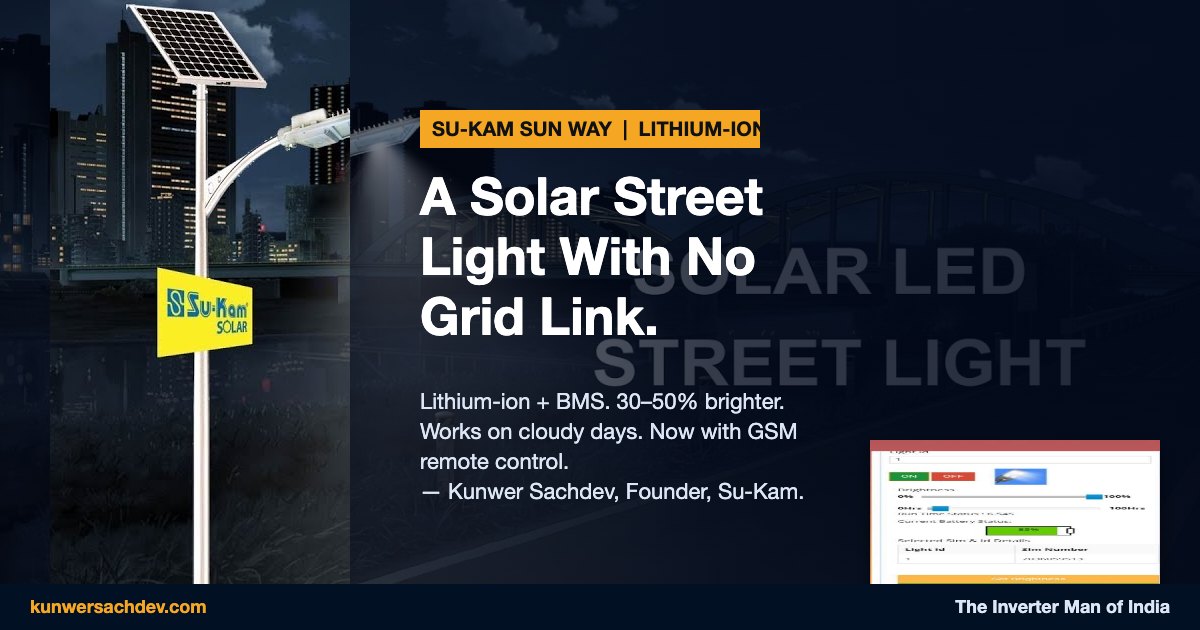
The export book wasn’t the easy markets. Many deployments were in places where grid power was either unreliable, intermittent or absent. The pitch was simple in any language: a unit that ships from India, designed to handle Indian grid behaviour, that will run a household, a clinic or a classroom when nothing else will. Su-Kam representatives showed up at trade shows like Middle East Electricity year after year, and by the mid-2010s the brand was being specified into government and donor-funded electrification tenders in markets where Indian manufacturers had previously been a footnote.
Pioneering Solar in India
Su-Kam moved into solar earlier than most Indian power-electronics companies. By the early 2010s the catalogue already covered solar inverters, off-grid systems, grid-tie inverters, PWM and MPPT solar charge controllers, solar PCUs and solar lighting — aligned with the launch of the National Solar Mission and the Ministry of New and Renewable Energy‘s first phase of off-grid programs [21][22].
In a 2018 pv magazine India interview, I argued that the company was “four to five years ahead of competitors” on inverter technology, and used the conversation to position Su-Kam squarely on solar hybrid systems — Solarcon, Brainy and the touchscreen PCU [23]. I carried two informal titles by then: the inverter man of India and, increasingly, the solar man of India [24].
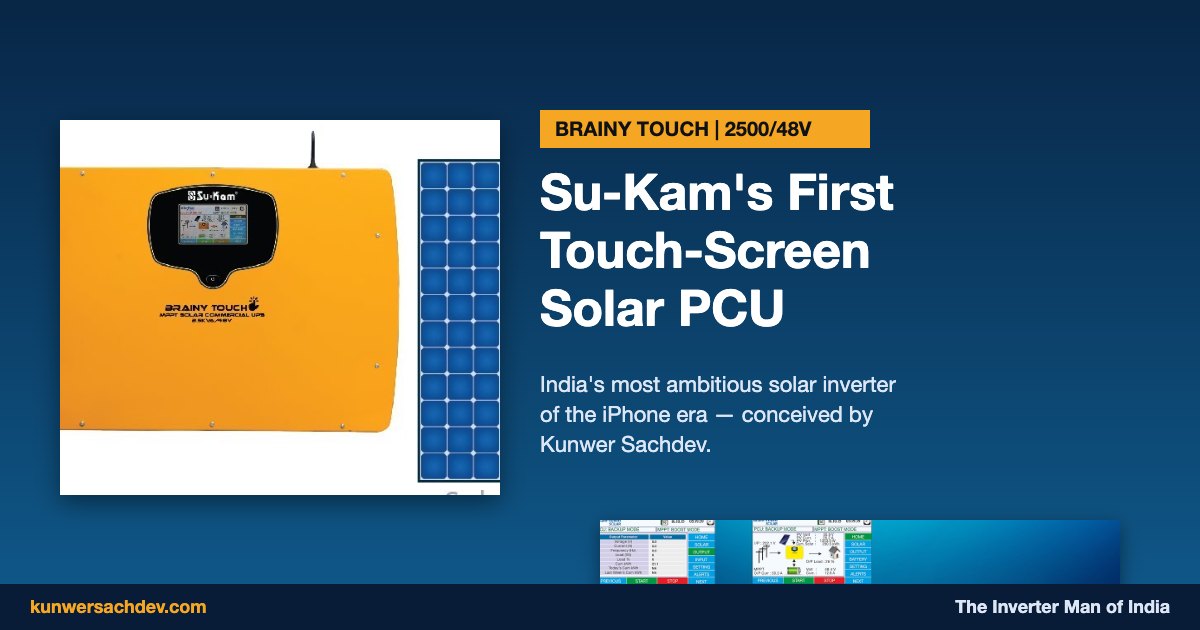
India’s grid was unreliable in exactly the geographies where solar irradiance was highest. A Su-Kam solar PCU sold into a Rajasthan farmhouse or a Gujarat shop did two jobs at once: it ran the load when the grid was down, and it offset diesel-generator hours when the grid was up. That dual-purpose framing — back-up first, sustainability second — let the brand sell solar to customers who would not have bought on environmental grounds alone. It was a category-design move of the same order as the original sine-wave plastic-body decision a decade earlier.
The Recognitions
- Ernst & Young Entrepreneur of the Year — 2011 [25]
- Bharat Shiromani Award — Government-of-India-affiliated honour for entrepreneurship and innovation [26]
- Entrepreneur of the Year — Entrepreneur India Awards, 2011 [27]
- Superbrands India — the first Indian power-solutions company so recognised [28]
- India Today — Innovation of the Decade — for the plastic-body inverter (Chic) [7]
- Connect the Dots by Rashmi Bansal — profiled as one of twenty entrepreneurs-without-an-MBA [29]
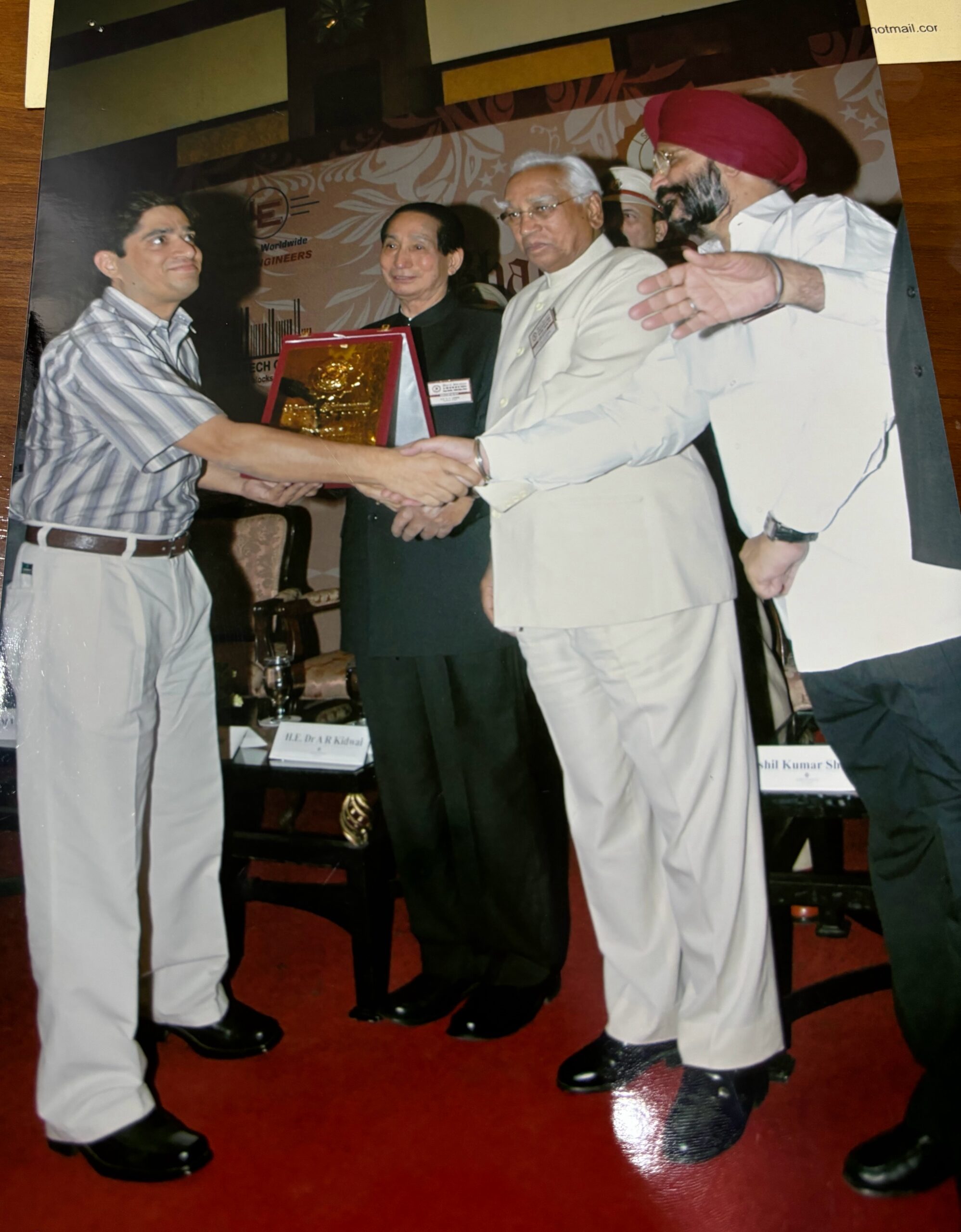
Two of those recognitions matter more than the rest. The Superbrand title — awarded on the strength of consumer recall and category leadership — was the clearest external acknowledgement that an Indian power-backup company had become a household name. The India Today “Innovation of the Decade” was the clearest acknowledgement that the underlying engineering was the real story.
The Brand in New Hands
Su-Kam is no longer mine. The brand, the factories, the patents, the dealer network — all of it passed through an NCLT resolution process and into the hands of new promoters in 2022. Today the company operates under the leadership of Navraj Mittal, Ashok Kumar Gupta, Vishnu Prakash Goyal, and Rajneesh Bansal.
The new ownership has announced ambitious plans: a ₹6,000-crore revenue target over five years, a 500 MW lithium-ion battery manufacturing facility in Baddi, Himachal Pradesh, and expansion into lithium-based energy storage and solar segments. The company reported revenue of ₹317 crore in FY2024 and continues to export across Africa and other markets. The Su-Kam name is still on inverters, batteries, and solar products sold through the same dealer channels we built over two decades.
I built the brand. I no longer run it. Whether the Su-Kam name continues to mean what it meant — Indian engineering, honest product, global ambition — is now a question for the people who hold it.
What I can say is this: the template is strong. The dealer network, the Superbrand recognition, the patent portfolio, the presence in ninety-plus countries — those were not built in a day, and they do not disappear with a change of ownership. The real test of any brand is whether it survives its founder. Su-Kam is now taking that test.
For the customer who bought a Chic in 2003 and is still running it, Su-Kam means the box that worked. For the new owners running Su-Kam in 2026, it means they inherited a working template — a domestic brand that was built, scaled internationally, and held against multinational competition for two decades. How they carry it forward will determine whether Su-Kam stands the test of time. That is the real question of the Su-Kam legacy now.
Sources & References
- Kunwer Sachdev — Wikipedia. Birth, family background, education at Hindu College and University of Delhi.
- YourStory — “With Rs.10000, this entrepreneur went on to build India’s first inverter company,” 2015. Cable-TV origins, ₹10,000 starting capital.
- ZaubaCorp — Su-Kam Power Systems Limited corporate registry record. Incorporation 14 October 1998; CIN U64201DL1998PLC096685.
- Zee News — “From selling pens to building a million-dollar empire”. Early-life narrative, brand-building.
- Su-Kam Power Systems — Wikipedia. Product firsts: MOSFET, microcontroller, DSP sine-wave, plastic body, touchscreen PCU.
- Brands Awareness — “Su-Kam Case Study: Rise, Fall & Rebirth of India’s Inverter Empire”. Chic plastic-body inverter, GE Plastics partnership.
- APN News — “From Pioneers to Defaulters”. India Today “Innovation of the Decade”, peak revenue ₹600 crore.
- pv magazine India — interview with Kunwer Sachdev, March 2018. Solarcon, Brainy, hybrid focus.
- Su-Kam — Brainy solar hybrid UPS product page.
- Su-Kam Power Systems — Wikipedia. India’s first touchscreen Solar PCU with MPPT and Wi-Fi monitoring.
- Brands Awareness. Patent and IP portfolio: 76+ technology patents, 189 copyrights, 136 trademarks, 88 design patents.
- APN News — “From Pioneers to Defaulters”. Peak market-share figure (>35%).
- Outlook India — “Su-Kam’s Ownership Transition Sets the Stage for Exciting Growth”. Superbrand status.
- TradeIndia — Su-Kam Power Systems Ltd. Gurugram facility profile.
- pv magazine India interview. Battery factory in Himachal Pradesh, in-house testing.
- Su-Kam Power Systems Limited — LinkedIn company page. Headcount band, manufacturer category.
- Su-Kam Power Systems — Wikipedia. Export coverage 90+ countries, dealer network.
- Sukam India blog — “Su-Kam lights up remote villages in Gabon”, January 2014. ~2,000 solar street lights.
- Su-Kam Power Systems — Wikipedia. 35 schools in Rwanda powered by Su-Kam solar systems.
- Tracxn — Su-Kam Power Systems company profile. Highest export-sales record.
- Ministry of New and Renewable Energy — Solar Off-Grid programme.
- Su-Kam Power Systems — Wikipedia. Solar product range.
- pv magazine India — Su-Kam interview, March 2018. “4–5 years ahead” claim.
- SiliconIndia — “Kunwer Sachdev: The Solar Man of India”.
- Entrepreneur India — Kunwer Sachdev award profile, 2013. EY Entrepreneur of the Year 2011.
- Kunwer Sachdev — Wikipedia. Bharat Shiromani Award.
- Entrepreneur India award profile. Entrepreneur of the Year 2011.
- Business Standard — “Su-Kam’s ownership transition sets the stage for exciting growth” (ANI). Superbrand recognition.
- Goodreads — Connect the Dots by Rashmi Bansal.
- Kunwer Sachdev — “The Su-Kam Legacy: A Brand That Will Stand the Test of Time”. Quoted phrasing on legacy.
- Josh Talks Hindi — Kunwer Sachdev episode.
- Outlook India — ownership transition piece. 2018 leadership change.
- APN News — “From Pioneers to Defaulters”. Late-2010s financial-pressure record.
- Kunwer Sachdev — LinkedIn. Angel investor / startup mentor positioning.
- Su-Vastika Systems Pvt. Ltd. — official site.
- Guardian Nigeria — “Su-kam founder, Kunwer Sachdev starts new firm, ‘Su-vastika'”.
- Kunwwer.ai — official site. Sachdev’s AI company.
- Su-Vastika press — Rotomag Enertec’s majority acquisition of Su-Vastika in 2025.
- The Economic Times — “Reliance Power Fund buys 20% in Su-Kam for Rs 45 crore”.