UPS & Smart Battery Charging Technology Explained
What UPS battery charging technology actually does
UPS battery charging technology — Most people buy a UPS for the backup. The engineering that actually determines its life, your electricity bill, and the safety of your appliances sits in a part of the box almost no one asks about: the charger.
Explore Lithium LFP energy storage and BMS technology at https://lithiuminverter.in and solar category innovations at https://solarmanofindia.com.
For founders seeking AI legal diagnostics and dispute risk assessment, explore Legal Shield on https://kunwwer.ai/.
A UPS is three machines in one box. Most buyers compare them on the third. The first one decides everything.
There is a question I have been asked thousands of times in three decades of building UPS systems in India: “Why has my electricity bill gone up since I installed the inverter?” The answer almost no one offers — because almost no one knows — is that the rise in your bill has very little to do with backup. It has everything to do with how the UPS charges your battery for the other twenty-two hours of the day.
A UPS is sold on a single promise: when the grid goes off, the lights stay on. That promise is real. But it is also the smallest part of what the machine actually does. For most of its life, your UPS is not inverting. It is charging. And the charger inside that box — its size, its intelligence, its sensitivity to temperature, its ability to slow down at the right moment — is the single component that decides three things you actually care about:
- How long your battery will lastTwo years, or eight, depending on how it was charged.
- How much your electricity bill will riseThe wrong charger silently wastes power every hour it runs.
- How safe your appliances will beFrom the fan that hums to the TV that flickers.
I want to walk you through what is happening inside that box. Not as marketing. As engineering. Because the more you understand about charging, waveform and switching time, the less likely you are to be sold a UPS that quietly costs you more than it saves.
The Charger Is the Brain
The charger inside a UPS does one job that sounds simple — push energy into a battery — and does it badly almost everywhere it is sold cheaply. The reason is that “pushing energy into a battery” is not a single act. It is a sequence of decisions, each of which depends on the kind of battery you have, the temperature of the air around it, and the voltage of the grid feeding it.
A well-designed charger operates in six stages. That phrase deserves explanation because it is genuinely the heart of the matter.
In the first stage — bulk charge — the charger pushes the maximum safe current into the battery, getting it to about 80% of capacity as fast as possible. Then something has to change. Because as a lead-acid battery approaches full charge, the electrolyte inside it begins to heat up. If you keep charging at the same speed, water inside the battery evaporates. The plates corrode. The battery dies in two years instead of six.
So a good charger slows down. Stage by stage, it reduces current — through absorption, boost, float, and trickle — each stage matched to where the battery is in its chemistry. And a great charger adds a sixth dimension on top: Automatic Temperature Compensation, or ATC.
Why “Fast Charging” Is Almost Always Wrong
“Fast charging” sounds like a feature. In most UPS marketing in India, it is sold like one. But for the dominant battery chemistry in Indian homes — the tubular lead-acid battery — fast charging is the single most reliable way to destroy the battery you just paid for.
A tubular lead-acid battery is engineered to be charged slowly. It needs a minimum of ten hours to take a full charge without damage. Anything faster causes plate sulphation and water loss. The customer notices nothing for the first year. By the third year, the battery that should have lasted six is dead. The customer blames the battery brand. The real fault was the charger.
This is why the question to ask a UPS salesman is not “does it charge fast.” It is “how big is the charger, and how is the current shaped over the charging cycle?” A well-designed 15 Amp charger fills a 150 Ah battery in roughly ten hours and a 200 Ah battery in roughly thirteen — slowly, deliberately, in the way the chemistry was designed for.
Different chemistries change the math entirely, which is what most buyers never get explained:
| Battery Chemistry | Correct Charge Time | Typical Lifespan | Maintenance |
|---|---|---|---|
| Tubular Lead-Acid | 10 hours minimum | 4–6 years | Regular water top-up |
| VRLA / SMF (Sealed) | 6–8 hours | 3–5 years | None |
| Lithium-ion (LFP) | 2–4 hours | 10–15 years | None (with BMS) |
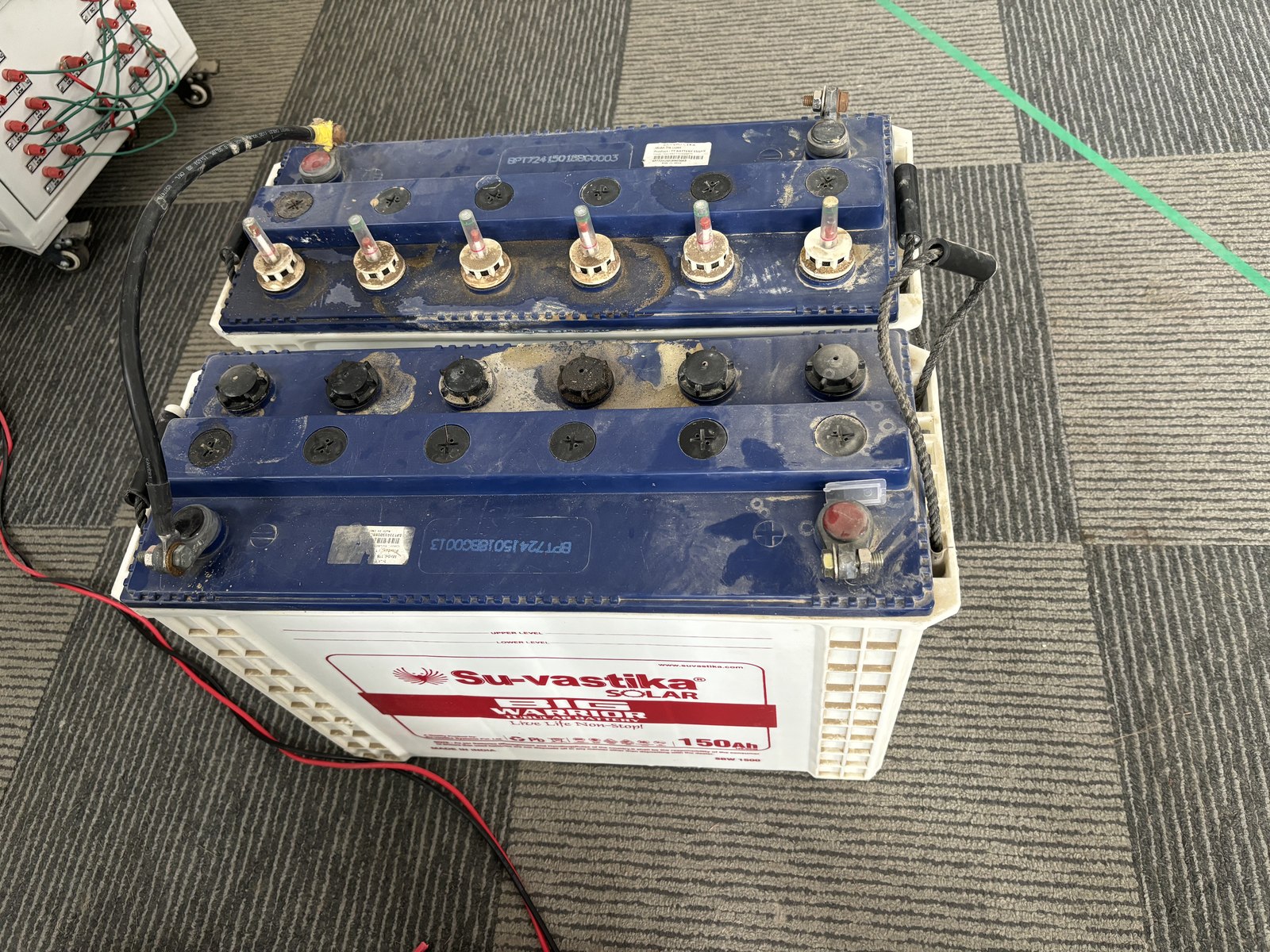
The Indian workhorse
Tall ribbed case, removable vent caps, tubular positive plates. Deep-cycle endurance — at the cost of a 10-hour charging window and quarterly water top-up. Built to be slow.
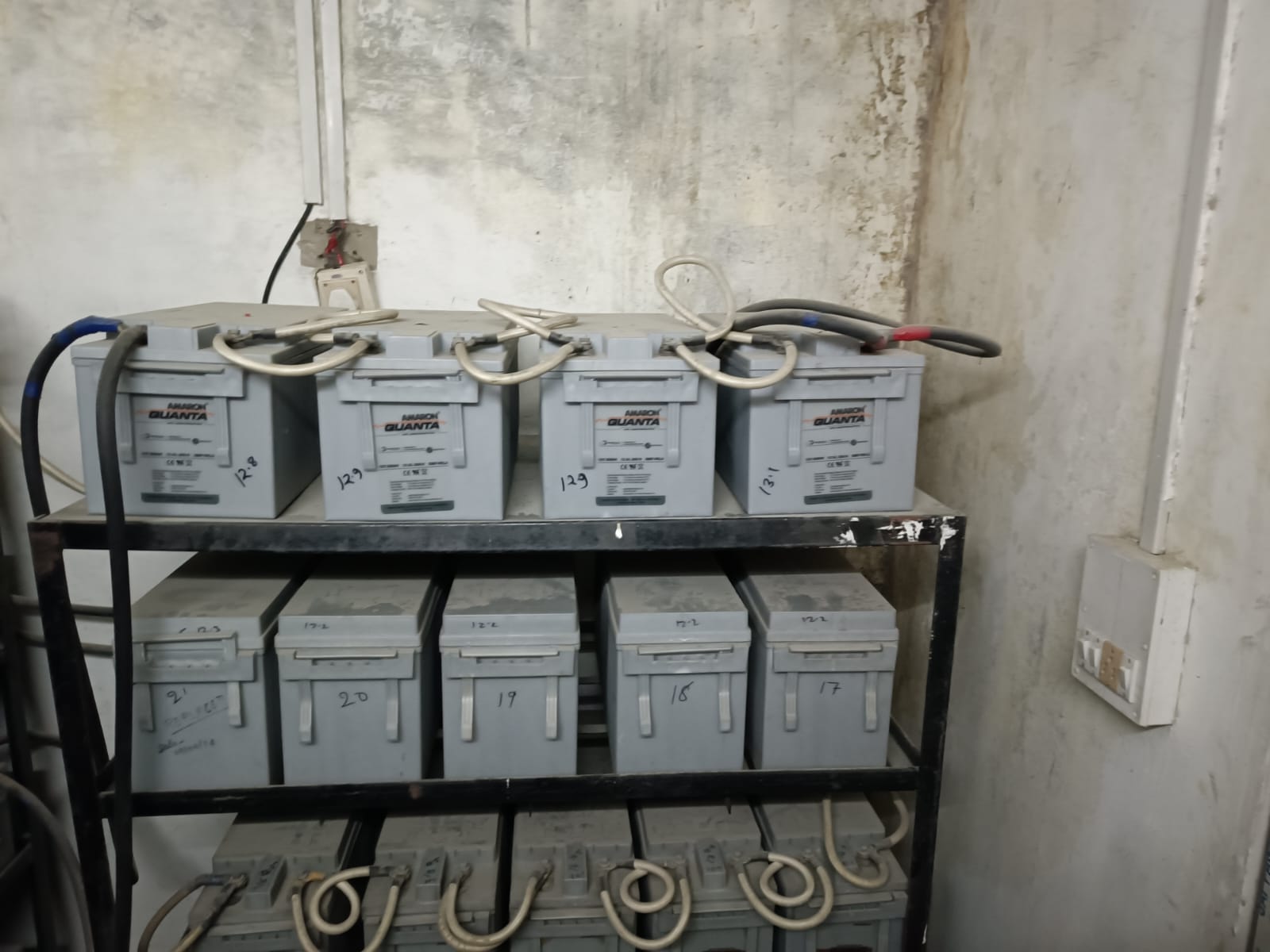
The set-and-forget
Sealed, no vent caps, no top-up. Acid is immobilised in glass mat or gel. Compact and stackable — common in telecom rooms, lifts and small backup banks. Shorter life than tubular, but zero maintenance.
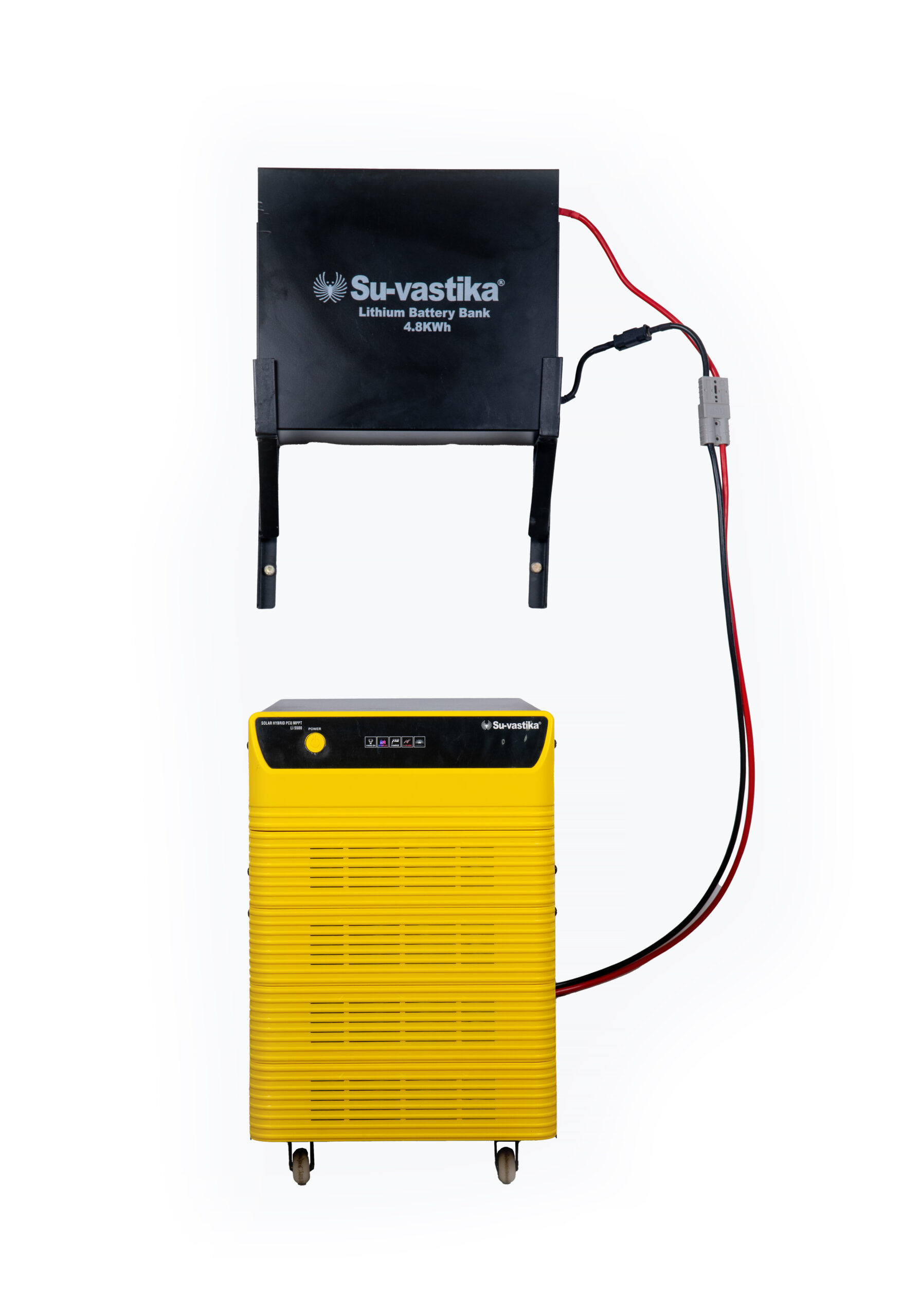
The new default
A fraction of the volume of a lead-acid bank, two-to-four hour recharge, ten-to-fifteen year life. The Battery Management System inside is mandatory — it throttles charging the moment any cell crosses a temperature threshold. Without the BMS, lithium is dangerous. With it, lithium is the future.
Lithium is the exception to the slow-is-better rule — but only because lithium chemistry was designed from the ground up to accept fast current and because every lithium pack worth buying has a Battery Management System that throttles charging the moment temperature crosses a threshold. Without that BMS, the same fast-charging that gives lithium its convenience is what makes it dangerous.
The charger is the silent contract between your wallet and your battery. Sign the wrong one and you pay every month for the next five years.
The Low-Voltage Problem No One Talks About
In urban India, grid voltage is roughly stable. In rural and semi-urban India, it is not. Voltage can sag to 140V on a summer afternoon and 100V on a winter evening when the load on the local transformer spikes. Most UPS chargers stop working below 140V. They simply switch off — silently — and the battery never gets fully charged. The customer thinks the UPS is fine. The battery slowly starves.
A well-designed charger keeps working down to 100V input. That single design choice — unspectacular, invisible on any product spec sheet — is the difference between a battery that lasts in a village and a battery that does not. If you live in a low-voltage area, this is the parameter to ask about.
What Happens When the Lights Go Off
Now to the part of the UPS most people actually think about: the inverter. When the grid drops, the inverter converts DC stored in the battery back into the AC your appliances need. Three things decide whether this conversion is graceful or destructive.
1. Waveform
The waveform that comes out of your wall socket from the grid is a pure sine wave. It is what every fan, every TV, every refrigerator, every laptop charger was engineered for. The waveform that comes out of a cheap inverter is a square wave, a modified sine wave, or a quasi-sine wave. These are all polite names for “not a sine wave.”
The damage shows up in small ways first. Your ceiling fan develops a hum. Your tube light starts to flicker. Over months, the harmonic distortion in those waveforms generates heat inside motor windings and electronic capacitors — heat that should not be there. The appliances do not fail dramatically. They fail quietly, six months early, and you blame the appliance.
Why would anyone build a UPS with anything other than a pure sine wave? Because square-wave inverters are cheaper to manufacture. That is the only reason. There is no defensible engineering argument for anything other than pure sine wave in a home or office.
2. Voltage and Frequency Stability
Indian appliances are designed for 200–230 volts at 50 Hz. A good inverter holds both tightly through the entire backup cycle, not just at the moment the battery is fresh. A weak inverter sags on voltage as the battery depletes, and the appliances downstream see a slow brown-out long before the UPS actually trips.
3. Switching Time
The moment the grid drops and the inverter takes over is the most dangerous moment in your appliance’s day. If the switch takes too long, your computer reboots. Your TV blanks. Your data is lost. A good UPS holds switching time below 5 milliseconds — fast enough that a desktop computer cannot detect the transition. You can be in the middle of a Zoom call. The grid goes off. The call continues. That is the goal.
The Electricity Bill Question
Back to the question I opened with. Why does the bill go up?
Two reasons, both invisible to the buyer at the point of sale.
The first is charger efficiency. A poorly-designed charger wastes thirty to forty percent of the energy it draws from the wall as heat. That heat does no useful work — it warms the room. You are paying for it. A well-designed charger pushes that waste down to ten to fifteen percent. Across a year of operation, the difference shows up directly on your bill.
The second is trickle charging done badly. After the main charging cycle ends, the charger is supposed to provide a tiny maintenance current — just enough to offset the battery’s natural self-discharge. A poorly-designed trickle stage keeps feeding the battery far more current than it needs, twenty-four hours a day. That excess current does two things at once: it inflates your bill and it shortens battery life through chronic mild overcharging.
This is the trap. Cheap UPS units are sold on a low price tag. They recover that low price from the customer slowly — through the electricity meter and through a battery that needs replacing twice as often as it should.
Six Questions to Ask Before You Buy
If you take only one thing from this piece, take this checklist. Walk into the shop. Read it out. If the salesman cannot answer five of the six, walk out.
- How many stages does the charger operate in?The honest answer is three at minimum, ideally six.
- What is the charger’s amperage, and how long does that take to fill a 150 Ah battery?The numbers should match your battery’s chemistry — roughly ten hours for tubular lead-acid.
- Does the charger include Automatic Temperature Compensation?In Indian climates, this is not optional. It is the difference between four years of battery life and seven.
- What is the minimum input voltage at which the charger still works?Below 140V is the minimum standard. Below 100V is excellent.
- Is the inverter output a pure sine wave?Anything else damages your appliances over time.
- What is the switching time when the grid fails?Under 10 milliseconds is acceptable. Under 5 milliseconds is what you actually want.
What the Box Is Really For
A UPS is not a backup machine. It is a battery management machine that occasionally does backup. Once you see it that way, the questions you ask change. You stop asking about charger architecture, waveform purity, switching time, low-voltage tolerance, and temperature compensation. These are the parameters that decide whether the box you bought will save you money or cost you money over the next decade.
I have spent thirty-three years building these boxes. The single most rewarding thing in this work has not been the patents or the brand. It has been the customer who, six years later, still has the same battery — because the charger inside the UPS quietly did its job for two thousand one hundred and ninety mornings in a row.
That is the engineering no one sees. It is the engineering that matters.
Frequently Asked Questions
What is 6-stage smart battery charging (DT-6S)?
DT-6S is a patented multi-stage charging algorithm that adjusts current and voltage based on battery chemical state to prevent overcharging and extend battery life.
What battery chemistry is best for Indian climates?
Tubular lead-acid is the standard for Indian homes because it withstands deep discharge cycles and irregular supply. VRLA (sealed) works for small UPS. Lithium-ion (LFP) is the future but requires a Battery Management System (BMS). Choose based on maintenance tolerance and budget: lead-acid needs quarterly water top-up; VRLA needs none; lithium needs no maintenance but costs 3–5× more upfront.
Why does a cheap UPS cost more over 5 years?
Low-price UPS units use poorly-designed chargers that waste 30-40% of energy as heat and poorly-managed trickle charging that overcharges the battery. A customer saves $100 at purchase but loses it within 2 years through higher electricity bills and a battery that dies 3 years early (needs replacing 2× instead of once). A well-designed UPS charger costs more upfront but saves money over the full product lifetime.
How long should a UPS battery really last?
Depends on charging quality and chemistry: tubular lead-acid lasts 4–6 years if charged correctly, 2–3 years if fast-charged; VRLA/SMF lasts 3–5 years (sealed, no top-up); lithium-ion (LFP) lasts 10–15 years if managed by BMS. The charger is the key variable. A 6-stage charger extends battery life by 50-100%. A simple 2-stage charger cuts it in half. This is why asking about the charger — not the battery — is the first question in UPS battery charging technology.
Can I use lithium batteries in an old UPS?
No. Most UPS chargers built for lead-acid cannot safely charge lithium batteries. Lithium requires a Battery Management System (BMS) to throttle current if any cell overheats. Without BMS, fast lithium charging is dangerous. If upgrading to lithium, you need a lithium-compatible charger (like Su-Kam’s 6-stage DT-6S algorithm with temperature compensation) or a purpose-built lithium UPS.
What’s the difference between UPS and inverter?
UPS = instant power when grid fails (backup mode, <5ms switching time). Inverter = continuous DC-to-AC conversion with no power loss. A UPS is actually a smart charger + battery + inverter in one box. Most people focus on the inverter (output quality) but ignore the charger (input quality) — and the charger is what decides battery life. An inverter with a weak charger fails silently over 2-3 years.

Founder, Su-Kam Power Systems (1988–2019) and Kunwwer.ai, and mentor at Su-vastika and several other companies — the “Inverter Man of India” and the “Solar Man of India.” Read his story →