Mint profiles Kunwer Sachdev in 2009 as Su-Kam readies its first big diversifications — automotive batteries, solar-LED lighting in Nepal, Nigeria and Malaysia, and a run at an IPO.
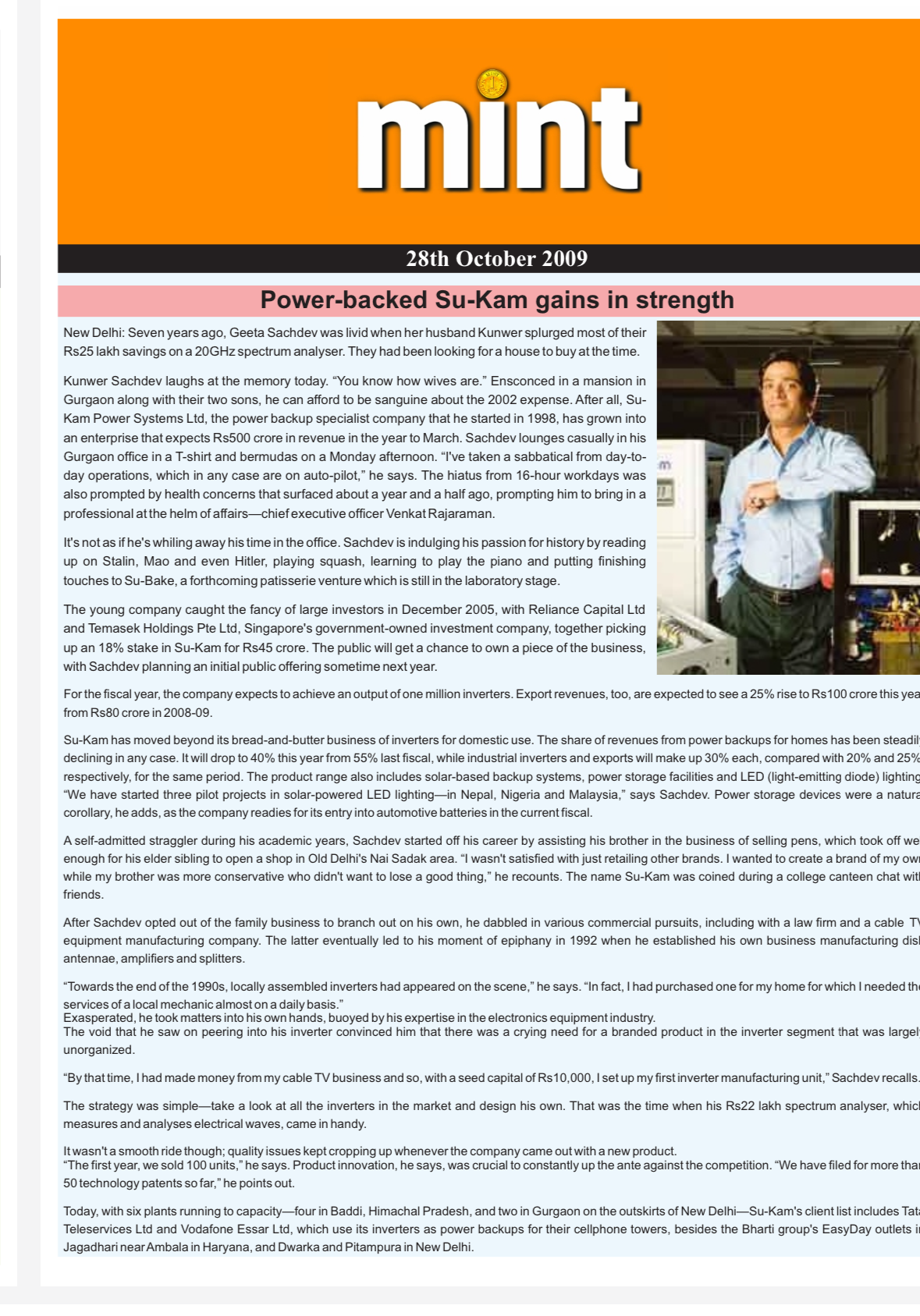
Mint Tejeesh N. S. Behl catches Kunwer Sachdev mid-transition — Su-Kam Power Systems has just crossed towards Rs 500 crore in projected annual revenue, the founder has stepped back from day-to-day operations, and the company is pushing well beyond its household-inverter comfort zone.
A Rs 25 lakh spectrum analyser and a very unamused wife
The scene Mint opens on has become part of Su-Kam folklore: seven years earlier, in 2002, Sachdev spent most of the couple Rs 25 lakh savings on a spectrum analyser — not the house they were looking to buy. His wife Geeta was, in his own words, “livid.” The instrument — used to measure and analyse electrical waves — became the tool that let Sachdev design honest, differentiated inverters. The house, eventually, followed on its own.
Auto-pilot at Rs 500 crore
By 2009 Su-Kam expected Rs 500 crore in revenue for the fiscal ending March 2010. Sachdev had taken a sabbatical from 16-hour workdays — partly for health reasons that surfaced 18 months earlier — and brought in Venkat Rajaraman as CEO to run the day-to-day. Off duty he was reading Stalin, Mao and Hitler, playing squash, learning the piano, and quietly putting the finishing touches to Su-Bake, a patisserie venture then still in the lab.
“I have taken a sabbatical from day-to-day operations, which in any case are on auto-pilot.”— Kunwer Sachdev to Mint • 28 October 2009
Reliance, Temasek and a coming IPO
Mint reminds readers of the December 2005 event that put Su-Kam on the map for institutional investors — Reliance Capital and Singapore Temasek Holdings picking up an 18 per cent stake together for Rs 45 crore. Sachdev told the paper he was planning an IPO in the following year, and had targeted output of one million inverters for FY2010. Export revenues alone were expected to jump 25 per cent to Rs 100 crore, from Rs 80 crore the year before.
Away from the household inverter alone
Mint documents the strategic shift plainly. Home power-backup, historically the company bread and butter, was expected to drop to 40 per cent of revenue from 55 per cent the previous year; industrial inverters and exports would each account for another 30 per cent. Su-Kam was also selling solar-based backup systems, storage kit and LED lighting, and had launched pilot projects in solar-powered LED lighting in Nepal, Nigeria and Malaysia. Power storage, Sachdev noted, was a natural next step — and the company was preparing to enter automotive batteries in the same fiscal.
From selling pens to a Gurgaon mansion
The Mint piece closes on the founder own arc — the self-described academic straggler who started by helping his older brother sell pens, opened a Nai Sadak shop, then split off to try law and cable-TV equipment, and in 1992 set up his own business making dish antennas, amplifiers and splitters. Buying an inverter for his own house at the end of the 1990s, and needing a local mechanic on it almost daily, was the trigger for Su-Kam — seeded, in 1998, with just Rs 10,000.